
Making an MPACT That Lasts: Shockwave Therapy for the Hard-to-Heal Equine Suspensory Injuries
By Steve Adair, MS, DVM, for Veterinary Practice News December 2025 Issue
Suspensory ligament injuries remain one of the most challenging conditions in equine sports medicine and equine musculoskeletal injuries. Whether affecting the proximal attachment or the branches, these injuries can disrupt training, limit performance, and, if inadequately treated, lead to chronic pain or compensatory damage in other musculoskeletal structures. The longer a horse compensates, the greater the risk of progressive pathology that may eventually require surgical intervention, retirement, or other deleterious options.
For clinicians, the goal is clear: intervene early, promote functional regeneration, and reduce pain - all without the complications of prolonged medication use or invasive treatment. Shockwave therapy has become a key tool in achieving that goal, offering a scientifically validated way to activate repair processes, restore circulation, and accelerate recovery in ligament and tendon injuries.
The Science Behind Shockwave Therapy
Shockwave therapy uses focused acoustic pulses to stimulate a biological response within damaged tissue. The process, known as mechanotransduction, transforms physical energy into a cellular signal that initiates repair. These high-pressure waves increase local circulation, stimulate fibroblast activity, and upregulate key growth factors such as vascular endothelial growth factor (VEGF), transforming growth factor beta (TGF-β), and insulin-like growth factor (IGF) (Bosch, 2009).
This biological cascade leads to angiogenesis, collagen remodeling, and improved cellular metabolism. In parallel, shockwave exerts an analgesic effect by temporarily disrupting nociceptive transmission and desensitizing nerve endings (Waguespack, 2011). The combination of regenerative activation and pain reduction allows earlier reintroduction of controlled exercise - an essential component of ligament rehabilitation.
Histological and imaging studies provide clear evidence of these effects. In an induced desmitis model, McClure (2004) demonstrated that horses treated with shockwave exhibited superior ultrasound and histological healing characteristics compared to controls. Improved fiber alignment and vascularity were noted after three treatments spaced at three-week intervals. Similarly, Gillis (2005) reported positive outcomes in horses with proximal suspensory desmitis treated with focused extracorporeal shockwave therapy, reinforcing its clinical relevance in hard-to-heal suspensory lesions.
Why the Suspensory Ligament Responds
The suspensory ligament is particularly well-suited for regenerative treatment because of its complex vascular and collagenous composition. Chronic injuries in this structure often show poor intrinsic repair and high recurrence rates when managed conservatively. Shockwave therapy directly targets these limitations by restoring microcirculation, stimulating extracellular matrix renewal, and reducing fibrotic deposition.
King (2018) noted that the strongest reported effects of shockwave are in ligamentous and tendinous tissue, with proximal suspensory desmitis among the most consistently improved conditions. In a more recent evaluation, Stein (2023) found that repeated electrohydraulic shockwave sessions in horses with suspensory and flexor tendon injuries significantly reduced lameness between the first and third treatments, confirming that cumulative effects occur with serial therapy.
Although ultrasound changes do not always correlate immediately with clinical improvement, shockwave’s ability to modulate pain and stimulate cellular repair makes it a valuable early intervention strategy. This allows the horse to begin controlled exercise earlier and to start the multimodal approach of healing.
Advancing Clinical Outcomes with MPACTVet Technology
The evolution of shockwave technology has transformed how clinicians approach equine rehabilitation. Traditional electrohydraulic units were powerful but loud, often necessitating sedation and clipping before treatment. The emergence of piezoelectric and impact systems, such as MPACTVet, have addressed these limitations.
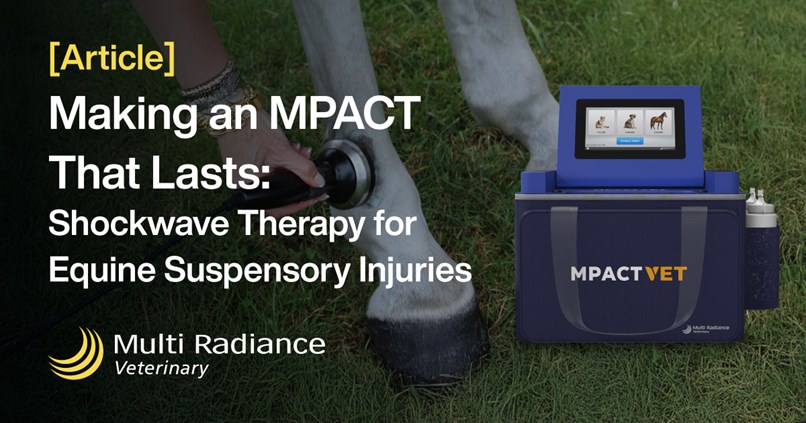
MPACTVet piezoelectric shockwave technology is quiet, precise, and efficient. Treatments are typically performed with the horse standing calmly, eliminating the need for sedation. The applied coupling gel ensures effective acoustic transmission without clipping the hair coat, improving both workflow and animal comfort. This noninvasive approach makes it easier to treat horses in barns or on the road while reducing stress for both patient and practitioner.
The lack of procedural barriers—no sedation, no clipping, no loud discharge—represents a major advance in the practical application of shockwave therapy. Horses tolerate MPACTVet therapy calmly, allowing accurate targeting of the lesion and more consistent dosing. These refinements are particularly valuable when treating elite performance horses that require precision and repeatability.
The Power of Synergy: Shockwave and Super Pulsed Laser Therapies
While shockwave initiates a regenerative cascade, the addition of super pulsed laser therapy (SPLT) enhances the modulation of inflammation and accelerates tissue repair. The rationale for combining the two is grounded in the complementary nature of their biological effects.
Shockwaves produce microinflammatory activation, increasing blood flow and cytokine signaling within the injured tissue. This transient inflammation is necessary for tissue repair but can become detrimental if excessive or prolonged. SPLT – delivering ultrafast, high-peak light pulses - acts at the mitochondrial level to balance this process. It stimulates cytochrome c oxidase, enhancing ATP production, reducing oxidative stress, and regulating inflammatory mediators (Leal Junior, 2019; Eells, 2020).
Pluim (2020) demonstrated that high-power laser therapy significantly improved healing in equine suspensory branch lesions, resulting in enhanced Doppler vascularity and collagen organization. Zielinska (2022) confirmed similar findings in tendon models, with laser-treated tissues showing superior fiber alignment and less edema. Giannini (2020) also reported significant clinical improvements in pain, swelling, and lameness in horses treated with high-intensity laser therapy compared to conservative management.
Together, shockwave and SPLT form a sequential regenerative strategy: shockwave stimulates angiogenesis and cell recruitment, while SPLT refines the inflammatory environment, guiding the tissue toward organized collagen formation. This synergy can produce more complete healing with less fibrosis and shorter recovery time.
Clinical Application and Timing
Effective treatment begins with accurate diagnosis through ultrasound or MRI to localize the lesion. Once the extent of suspensory involvement is established, the therapeutic plan should integrate both mechanical and photobiological stimulation. Shockwave is typically applied in one to three sessions spaced 14 to 21 days apart, delivering 1500–2500 impulses per session depending on lesion depth, lesion size, and device type. Treatments should be initiated early in the healing process to maximize regenerative activation. SPLT can be introduced immediately after injury and again after the first shockwave session and continued multiple times per week throughout the early inflammatory and proliferative phases. SPLT treatments are allowed at FEI events and barns.
Clinically, practitioners often observe a marked reduction in pain and swelling within the first few treatments. Horses become more comfortable under load, allowing a gradual reintroduction of controlled exercise. Follow-up ultrasound commonly reveals improved fiber patterns and decreased lesion cross-sectional areas within two to three months.
Making an MPACT That Lasts
Shockwave therapy—especially when combined with super pulsed laser therapy—has reshaped how clinicians manage hard-to-heal equine suspensory injuries. Its ability to reduce pain, stimulate healing, and avoid sedation or invasive procedures aligns with the growing emphasis on regenerative medicine in equine care.
The MPACTVet piezoelectric shockwave therapy system embodies these principles. Its quiet operation, portability, and precision targeting make it a practical and powerful therapeutic tool in the field. More importantly, by addressing the underlying pathophysiology of suspensory ligament injury - rather than simply masking pain - it helps clinicians truly make an impact that lasts.